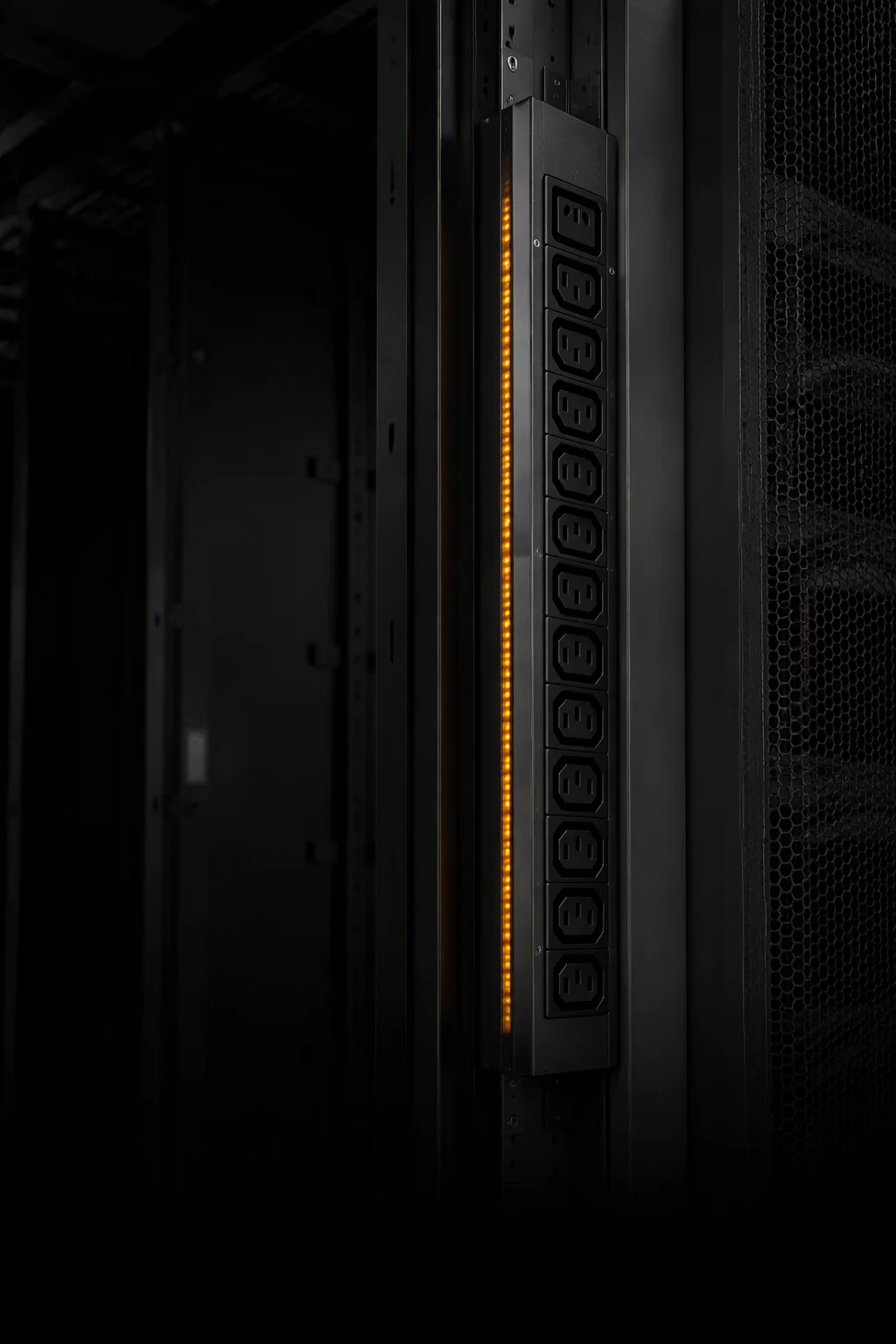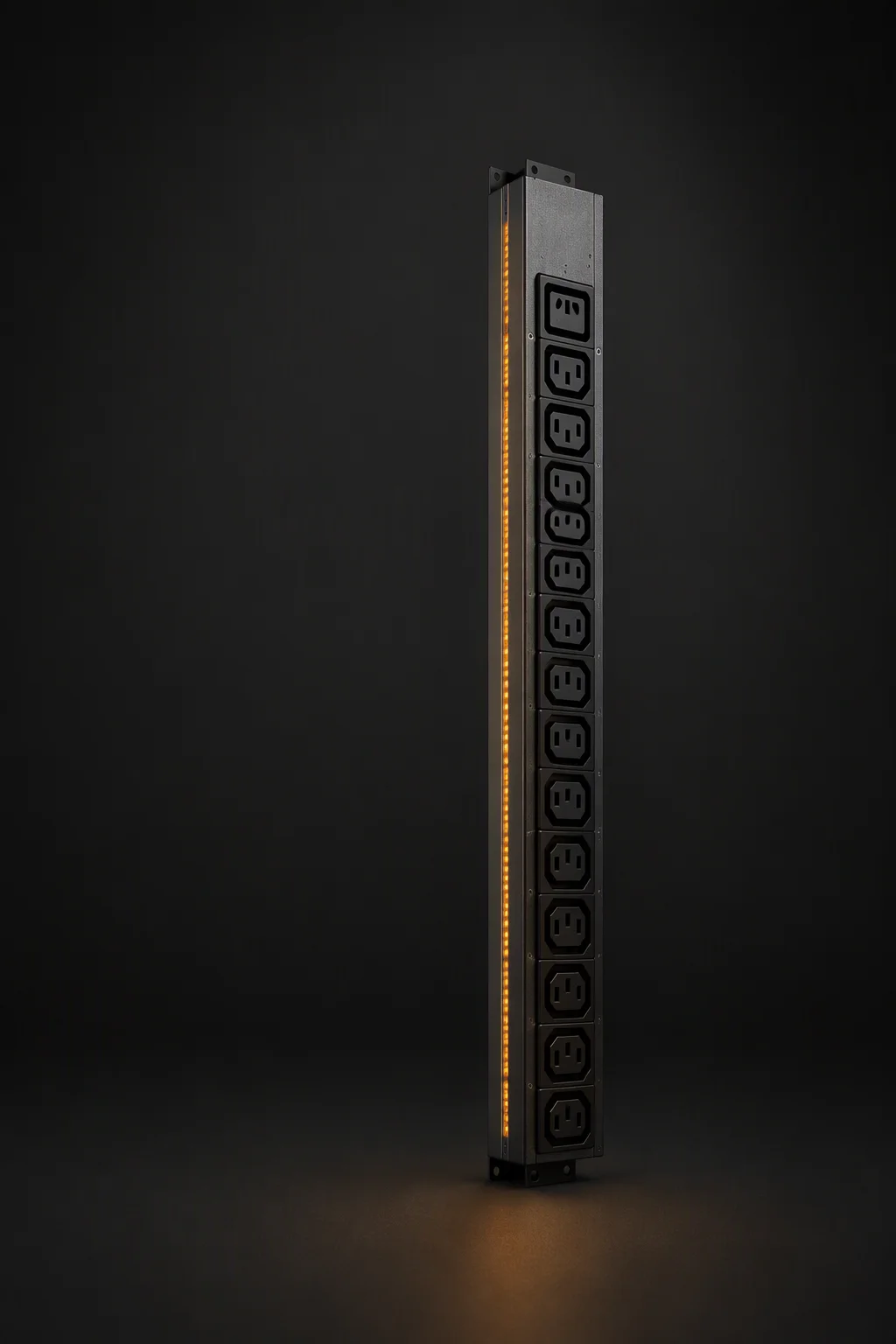
AI Rack Power · X-Series
Racks this dense need a PDU that pays attention.
AI racks are heading from 40kW toward 120kW. The X-Series watches every feed for load steps, harmonic drift and thermal creep — and forecasts your remaining headroom from the rack's own kWh history.
// anomaly watch — sample telemetry
Catch the failure before the checksum does
A failing PSU shows up as a load step. A degrading capacitor bank shows up as rising THD(i). A blocked airflow path shows up as slow temperature drift on a sensor. The X-Series baselines each rack's normal curve from rolling kWh history, then flags the deviations — load-step anomalies, harmonic degradation, sensor drift — to your NMS as SNMP traps or MQTT events, with capacity forecasts riding the same stream. The readouts above are sample values; on your rack they would be yours, updating every second and exportable with a timestamp for every threshold crossing.
Sensing & integration
One gateway per rack, four senses included
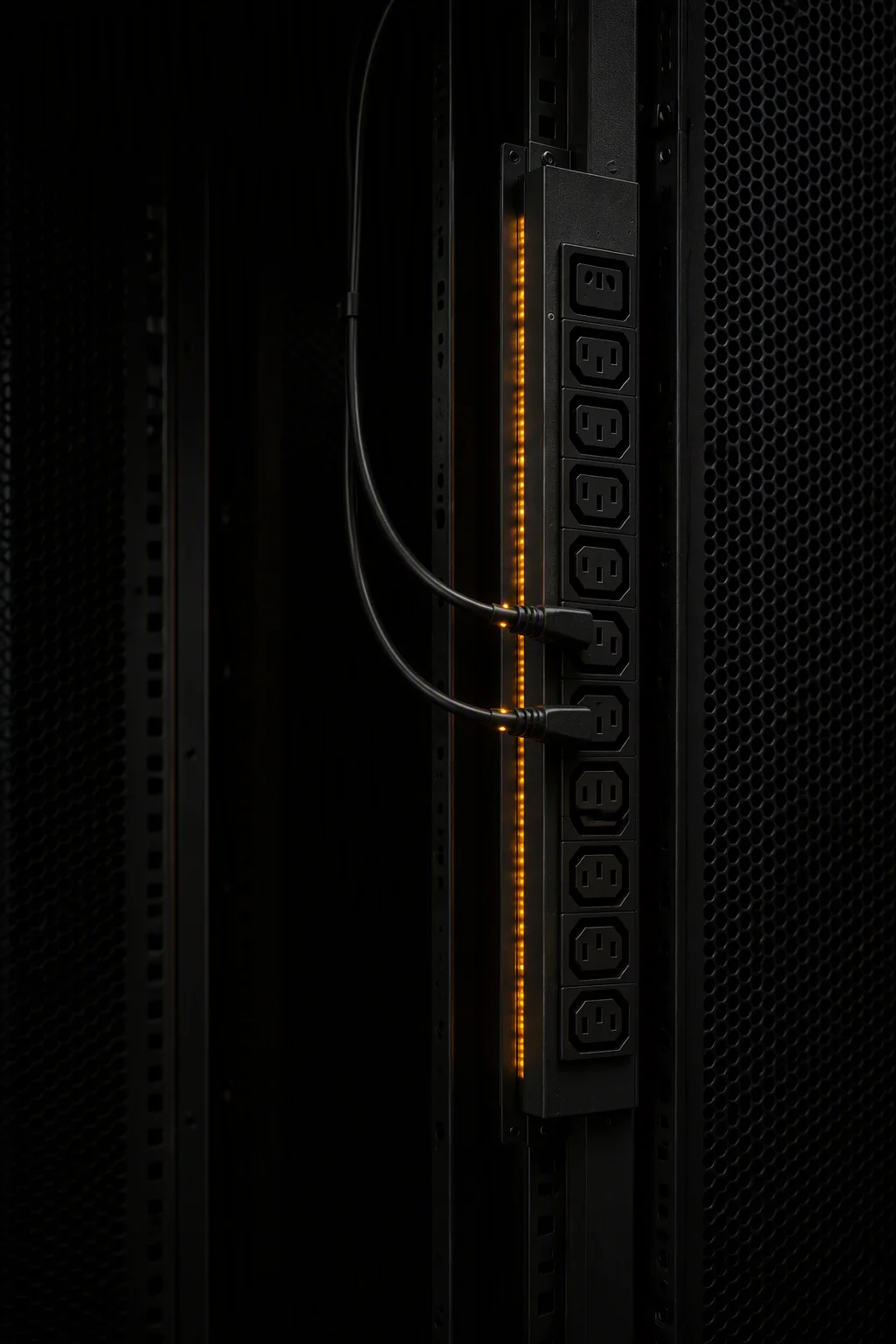
The network module is the gateway: SNMP v3 and REST into your DCIM, MQTT out to AWS IoT or Azure IoT, and daisy-chaining for up to 8 units on a single IP. No extra edge box to buy, rack, patch or license per cabinet.
Four RJ12 ports take the sensor kit — temperature and humidity on the intake path, door contact on the cage, leak rope under the raised floor. Density is the whole point: high-power three-phase builds deliver up to 36kW per 0U vertical (63A, 415V WYE), and liquid-cooled AI racks still need leads, breakers and metering done properly on the AC side.
Planning a row of dense cabinets? Start from two feeds per rack and keep the third for growth — the capacity forecasts will tell you when the second feed stops being enough, weeks before the breaker finds out for you.
- Sensor portsRJ12 ×4
- TelemetrySNMP v3 · REST · MQTT
- Daisy-chain8 units / IP
- Max feed63A 3φ · 36kW
Capability matrix
What the X adds, line by line
The X-Series inherits everything from the metered and switched grades and adds the analytics layer — this is exactly where the platform boundary sits, grade by grade.
| Capability | Basic | Metered | Switched | AI Rack Power |
|---|---|---|---|---|
| Unit & phase telemetry (V, A, kW, kWh, PF) | — | ±1% | ±1% | ±1% |
| Per-outlet current & kWh | — | — | — | ±1% A · ±2% kWh |
| Per-outlet switching | — | — | 100k-cycle relays | 100k-cycle relays |
| Telemetry interval | — | 1 s | 1 s | 1 s |
| THD(i) harmonic monitoring | — | — | — | Degradation alerts |
| Load-step anomaly detection | — | — | — | Yes |
| Capacity forecasting | — | — | — | From kWh history |
| Energy & carbon reporting | — | — | — | Yes |
| Environmental sensor ports | — | RJ12 ×2 | RJ12 ×2 | RJ12 ×4 |
| Protocols | — | SNMP · HTTP(S) | SNMP v3 · REST | SNMP v3 · REST · MQTT |
| Daisy-chain per IP | — | 8 | 8 | 8 |
| Cloud integration | — | — | — | AWS IoT · Azure IoT |
The density math is why analytics belong on the power strip. AI racks already run 40-120kW per cabinet, fed by three-phase distribution — at those numbers a single cabinet carries two or more 0U units, and each one is an instrument point with a breaker, a cord and a metering channel on every watt in. Liquid cooling takes the heat out, but the electrical picture still assembles itself at the PDU: phase loads, inrush behavior, harmonic content and the temperature story from the sensor kit. Collect it at the source and the anomaly detection has something honest to baseline against; skip it and your capacity plan is a spreadsheet's guess.
Onboarding
Onboard a rack in three moves
Rack and power
Mount the 0U vertical or 1U horizontal, land the feeds, power up. DHCP gets the unit online and the Web UI is in front of you within minutes — no driver discs, no serial console ritual.
Connect your stack
Point DCIM at SNMP v3 or REST, or bridge to AWS IoT / Azure IoT over MQTT. MIB files and API references ship with every order on request, so integration is a config task, not a project.
Let the baseline learn
The X-Series profiles each rack's normal load curve from rolling history, then tunes its anomaly thresholds to that curve — not to a generic template. Alerts route as SNMP traps, MQTT events or email; you keep the raw 1-second data either way.
Point us at your densest rack
Send the target kW per rack, feed and outlet plan — an engineer replies within 48 hours with a three-phase X-Series spec, sensing laid out and FOB quoted. Custom high-density builds run 14-30 days.