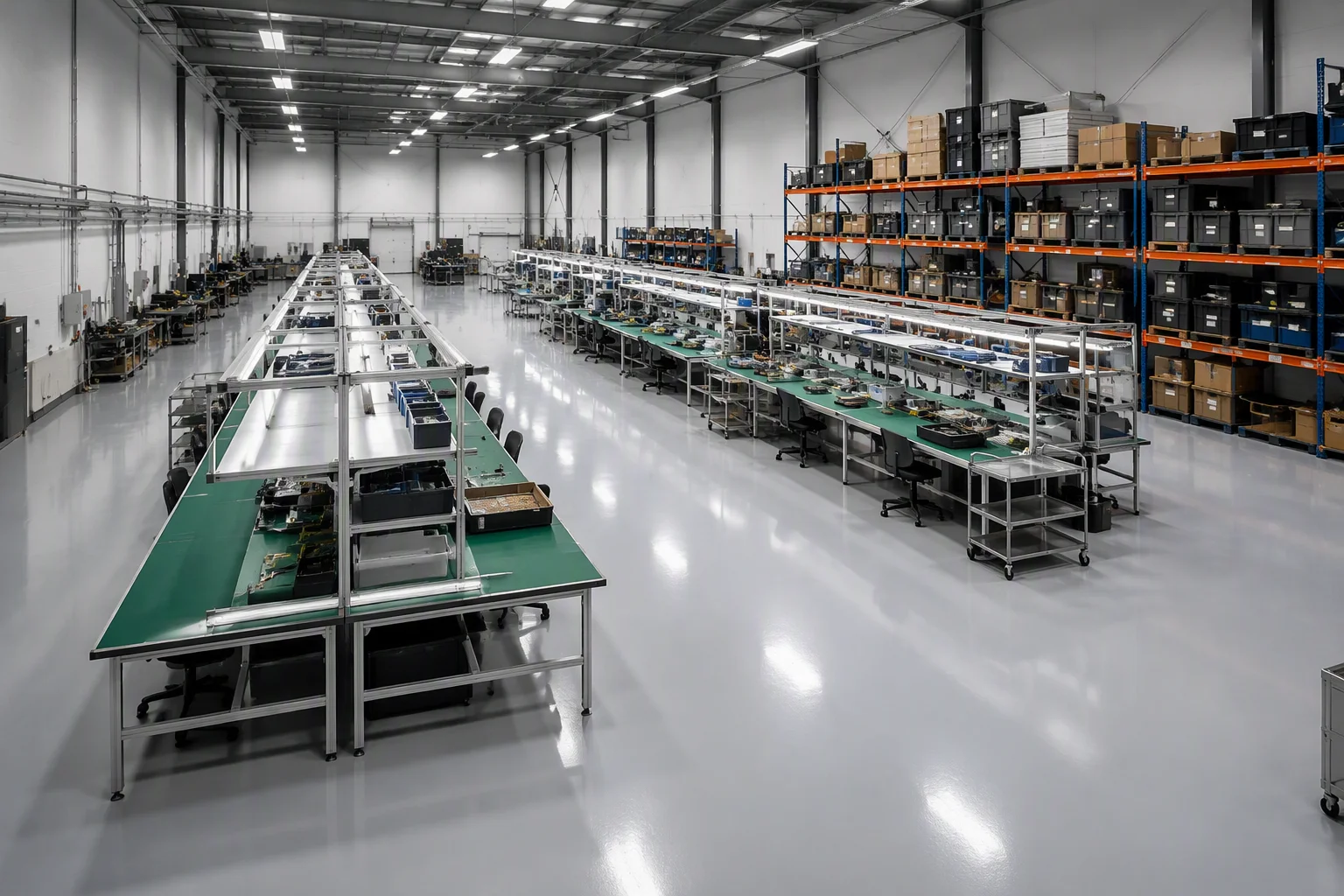
Inside the AmpRack works
Inside the works
Follow a rack PDU from SMT panel to loading bay: nine stations, four assembly lines, a calibration lab and a burn-in floor that touches every serial number before it ships.
Station zero
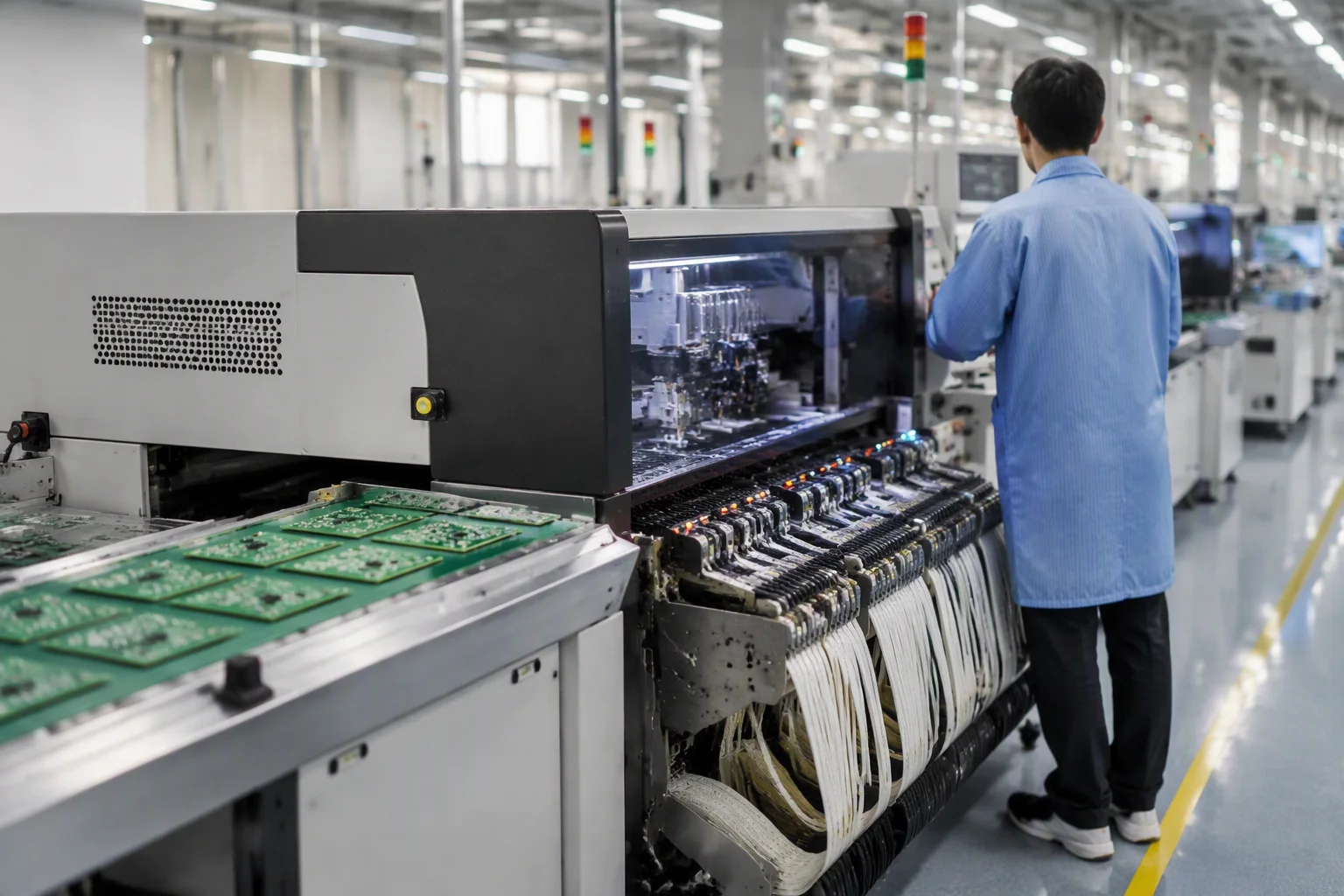
Our own SMT line, our own boards
The metering and control boards at the heart of every AmpRack PDU are placed, reflowed and AOI-inspected in-house — the brain of the product is never outsourced. Every panel is compared against a golden-sample library, so the ±1% metering front-end is built identically on every shift.
Owning the line changes the conversation with customers: a firmware-branded variant or a revised metering profile is a corridor conversation with the engineers who run the reflow profile, not a purchase order to a third party. Board revisions land in days.
The process chain
Nine stations from panel to pallet
SMT placement
Metering and control boards start on the in-house SMT line. Stencil, placement and reflow parameters are locked per board revision, so tolerance-critical components land the same way on every run.
AOI inspection
Automated optical inspection checks every panel — solder joints, polarity, component offset — against the golden-sample library. A suspect panel stops at this bench and never reaches assembly.
THT wave soldering
Relay and busbar boards go through through-hole wave soldering. High-current paths run 2.5mm² internal copper, sized for 10kA breaking coordination behind the branch breakers.
Assembly & wiring
Four assembly lines build the chassis: IEC 60309 or NEMA input cords, hydraulic-magnetic breakers from 9-63A, and C13/C19 outlet groups of 8-48 positions in 1U or 0U format.
Calibration
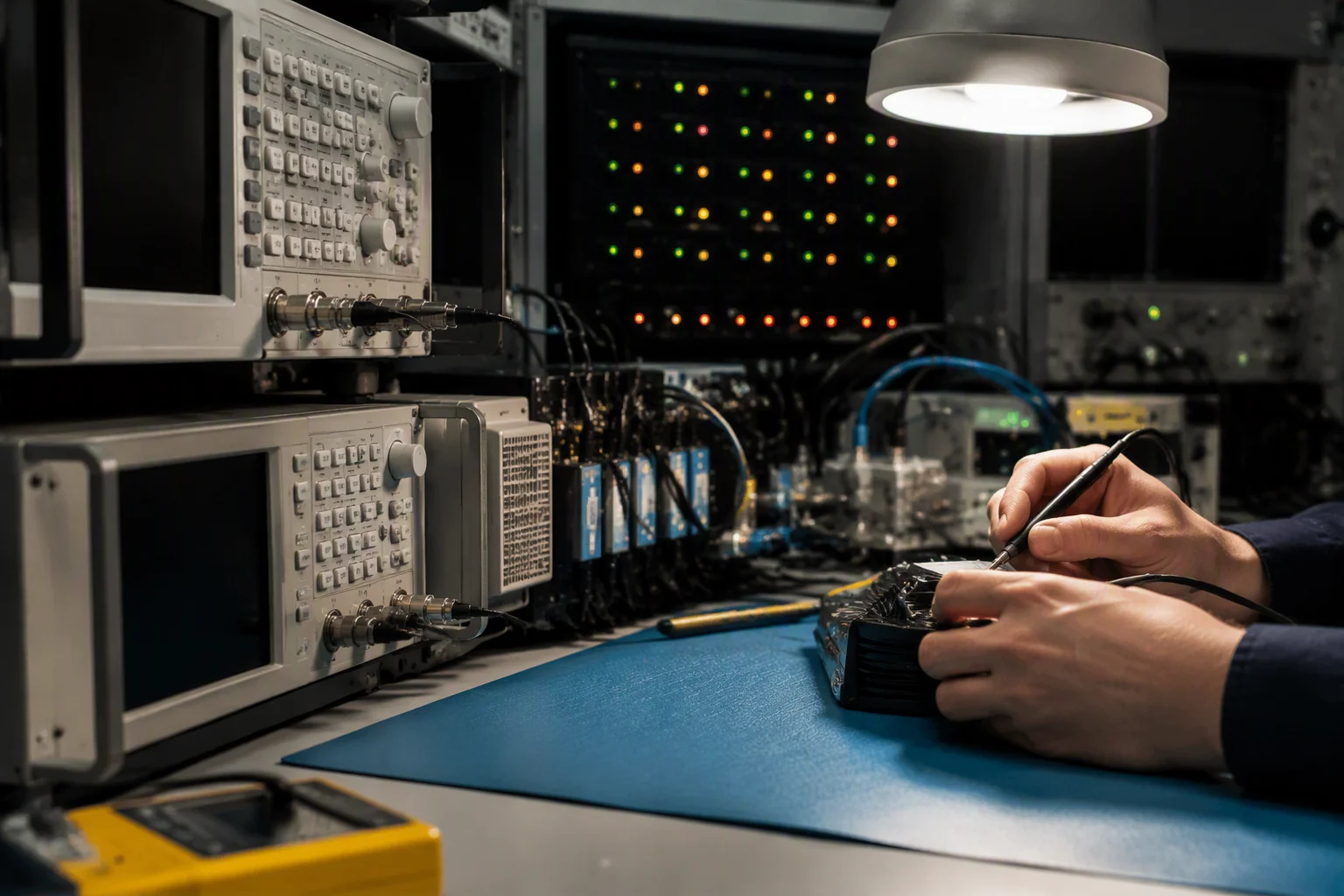
Every metering unit is trimmed on a reference-source bench across defined load points until readings hold inside ±1% — billing grade, per the IEC 62053-21 class 1 methodology — and receives its own calibration record.
Functional test
Scripted benches energize each outlet in turn, read back its state, and run an SNMP walk plus REST calls against the full OID tree. Nothing leaves this station on a spot-check.
Hipot
1500V AC dielectric withstand, input-to-ground and input-to-output, applied to every unit. A failure here stops that serial number for teardown — it is never a batch-level decision.
Burn-in
48 to 72 hours at full rated load in purpose-built burn-in racks, with telemetry polled throughout. Drift, thermal and relay outliers are pulled from the rack and dissected.
Packing
Anti-static bag, box, then cartons of 4-8 units that are drop-checked before handoff. Packing lists carry the serial range for FOB, CIF or DDP collection.
Station five, up close
Where ±1% is earned
Billing-grade metering is a promise someone will invoice against, so it is proven per unit rather than per batch. On the calibration bench each metering PDU is stepped through its load points and trimmed against the reference source; the resulting record — serial number, points, deviations — is archived and can travel with your order.
The same lab verifies per-outlet meters to ±1% current and ±2% energy, and re-checks units after firmware changes — a UI update must never move a billing number. How these benches slot into the wider gate system is laid out on the quality page.
Capacity, plainly
What the works turn out
assembly lines dedicated to rack PDU builds, flexing across metered, switched and outlet-metered orders
units per month at plan rate — tens of thousands of PDUs a month across the four product families
of full-load burn-in per unit before release, with telemetry polled the whole time
of units through calibration, function, 1500V hipot and burn-in — no sampling plans on outgoing test
Come see what the line can build for you
Send input, outlet map and quantity — we reply within 48 hours with a datasheet, a lead time and the test records behind them. Private-label builds are covered under OEM / ODM.